
Bill Gates apologizes to foundation staff for Jeffrey Epstein ties
Microsoft co-founder admits affairs and calls meetings ‘huge mistake’ but denies involvement in Epstein’s crimes
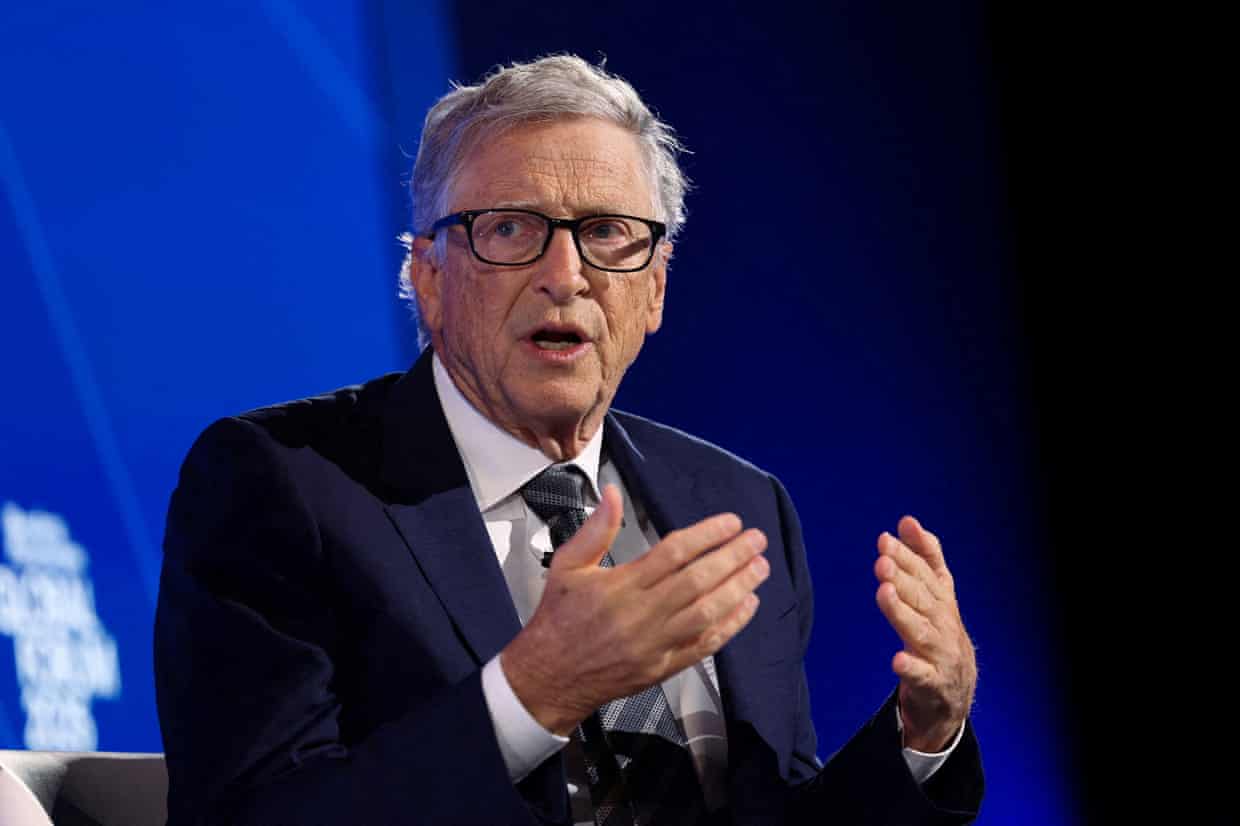
Bill Gates apologized to staff of his foundation for his ties to Jeffrey Epstein and admitted to two affairs but stated he did not participate in the convicted sex offender’s crimes, according to a Wall Street Journal report.
At a town hall on Tuesday, Gates, the Microsoft co-founder and billionaire philanthropist, said it was a “huge mistake to spend time with Epstein” and to bring Gates Foundation executives to meetings with Epstein.
“I apologize to other people who are drawn into this because of the mistake that I made,” Gates said, according to a recording reviewed by the Journal.
Gates’s relationship with Epstein has received increased scrutiny recently due to the justice department’s release of the files that included emails Epstein wrote to himself in which he claimed that Gates had contracted a sexually transmitted infection and requested antibiotics to surreptitiously give to his then-wife, Melinda. Gates has denied this allegation.
The files also contained images of Gates with women whose faces were redacted. He said during the town hall that Epstein had asked him to take the photos with his assistants.
“To be clear, I never spent any time with victims, the women around him,” said Gates, whose foundation is one of the world’s leading global health philanthropies.
Still, the men’s relationship was definitely “the opposite of the values of the Foundation and the goals of the Foundation”, he said. “And our work is very reputational sensitive. I mean, people can choose to work with us or not work with us.”
A foundation spokesperson told the Journal that the billionaire holds town halls twice a year and “spoke candidly, addressing several questions in detail, and took responsibility for his actions”.
Gates said he started meeting with Epstein in 2011. Epstein had pleaded guilty in 2008 to soliciting a minor for prostitution.
Gates said at the town hall that he was aware of some “18-month thing”, referring to Epstein’s sentence, that had limited Epstein’s travel but didn’t properly check his background.
While Gates claimed that he never spent time with Epstein’s victims, he did say that he had an affair with a “Russian bridge player who met me at bridge events, and one with a Russian nuclear physicist who I met through business activities”.
Epstein had tried to extort Gates over his alleged affair with the bridge player, Mila Antonova, after he could not convince the philanthropist to join a multibillion charity fund he tried to establish, the Journal reported in 2023.
“The tone of the message was that Epstein knew about the affair and could expose it,” the Journal reported.
Gates said during the town hall that Epstein spoke about the “intimate relationship he had with a lot of billionaires, particularly Wall Street billionaires”, and that he could help raise money for causes like global health.
The fact that other prestigious figures attended their meetings “made it easier for me to feel like this was a normalized situation”.
An incredible self-own
In 1936, John Scott, son of the late Guardian owner and legendary editor CP Scott, did something unheard of for a media heir: he gave up his stake for the greater good.
After inheriting the newspaper, Scott renounced all financial benefit – bar his salary – in the Guardian (worth £1m at the time and around £62m today) and passed ownership over to the newly formed Scott Trust. The Trust would evolve to have one key mission: to secure the financial and editorial independence of the Guardian in perpetuity.
That means the Guardian can’t be bought. Not by private equity, not by a conglomerate, and definitely not by a billionaire looking for a political mouthpiece. So here are three good reasons to make the choice to support us today.
1. Our quality, investigative journalism is a scrutinising force at a time when the rich and powerful are getting away with more and more.
2. We are independent and have no billionaire owner controlling what we do, so your money directly powers our reporting.
3. It doesn’t cost much, and takes less time than it took to read this message.
This unique model also means we depend on readers like you from Algeria to help fund our work. Our independence means we can say what we want, report on who we want, challenge who we want, and stand up at a time when others are sitting down. If you would rather the news you read was the result of decisions made by journalists and editors, not shareholders or ultra-wealthy tech bros, then, well, you know what to do: Support the Guardian on a monthly basis.
Post a Comment